Monday, February 27, 2017

Free PDF Professional Counseling: A Process Guide to Helping (8th Edition)By Harold L Hackney, Janine M. Bernard

Free PDF Professional Counseling: A Process Guide to Helping (8th Edition)By Harold L Hackney, Janine M. Bernard

This concept is because we offer the soft documents of the book. When other people bring the hard book anywhere, you can only hold your gadget. Conserving the soft data of Professional Counseling: A Process Guide To Helping (8th Edition)By Harold L Hackney, Janine M. Bernard in your gadget will alleviate you in analysis. When you are going to residence, you could additionally open in the computer system. So, conserving the book soft data in some tools are offered. It will certainly simplify of you to discover how the task is going to be really straightforward due to the advanced innovation.

Professional Counseling: A Process Guide to Helping (8th Edition)By Harold L Hackney, Janine M. Bernard

Professional Counseling: A Process Guide to Helping (8th Edition)By Harold L Hackney, Janine M. Bernard


Professional Counseling: A Process Guide to Helping (8th Edition)By Harold L Hackney, Janine M. Bernard


Free PDF Professional Counseling: A Process Guide to Helping (8th Edition)By Harold L Hackney, Janine M. Bernard

Following your should constantly meet the inspiration to acquire everybody is now simple. Connecting to the internet is just one of the short cuts to do. There are numerous resources that offer and connect us to other world problem. As one of the items to see in net, this internet site comes to be a really available area to seek plenty of resources. Yeah, sources concerning guides from countries worldwide are supplied.

After getting such information from us about this book what should you do? Once again, this is an ideal book that is created specifically for you, the individual who loves reading a lot. You are the visitors with big curiosity and also you will certainly not quit of a publication. Professional Counseling: A Process Guide To Helping (8th Edition)By Harold L Hackney, Janine M. Bernard truly exactly what you require currently. You may not be odd with this title of guide, may not you? It is not the moment that you will quit to finish. You could finish it every single time you want.

Just how is making sure that this Professional Counseling: A Process Guide To Helping (8th Edition)By Harold L Hackney, Janine M. Bernard will not presented in your shelfs? This is a soft documents publication Professional Counseling: A Process Guide To Helping (8th Edition)By Harold L Hackney, Janine M. Bernard, so you could download Professional Counseling: A Process Guide To Helping (8th Edition)By Harold L Hackney, Janine M. Bernard by acquiring to obtain the soft file. It will reduce you to review it every single time you need. When you feel careless to relocate the printed publication from home to workplace to some place, this soft documents will relieve you not to do that. Considering that you could just conserve the information in your computer unit and device. So, it enables you read it anywhere you have willingness to review Professional Counseling: A Process Guide To Helping (8th Edition)By Harold L Hackney, Janine M. Bernard

The selection of you to read this publication is not based on the force to read it. it will certainly start to make you feel that this book is very appropriate to read in this time. If sometimes you will also write your ideas into a book, discovering form this publication is an excellent way. Professional Counseling: A Process Guide To Helping (8th Edition)By Harold L Hackney, Janine M. Bernard is not only the reading book. It is a book that has impressive experience of the world. The book influences to get far better future. This is the reason why you must read this book, even the soft documents book, you can get it. This is just what you require now to test your principle of habit.

Professional Counseling: A Process Guide to Helping (8th Edition)By Harold L Hackney, Janine M. Bernard

Note: This is the bound book only and does not include access to MyCounselingLab® with Pearson eText. To order MyCounselingLab® with Pearson eText packaged with the bound book, use ISBN 0134497635.


Bridging the gap between theory and practice, Hackney and Bernard’s The Professional Counselor offers a solid grounding in counseling skills and an understanding of how these skills are used within different therapy orientations, including affective, cognitive, behavioral, and systemic domains. It presents students with a four-stage model of counseling which shows them how to assess client problems, develop counseling goals, define strategies and select interventions, and terminate and evaluate the counseling relationship. The new co-author of this edition, Janine M. Bernard, brings her expertise in clinical supervision to help deconstruct the counseling process for learners, resulting in effective editing of all chapters in this edition. Also included is a discussion of the application of counseling interventions to Dialectical Behavior Therapy and Motivation Interviewing, so that students can appreciate that skills are not distinct from therapy approaches they will use in their clinical courses. Included are new case examples drawing from different specialties within counseling, and more than 40 new web-based video samples illustrating the content of the book.


Also available with MyCounselingLab®

This title is also available with MyCounselingLab—an online homework, tutorial, and assessment program designed to work with the text to engage students and improve results. Within its structured environment, students see key concepts demonstrated through video clips, practice what they learn, test their understanding, and receive feedback to guide their learning and ensure they master key learning outcomes.


  • Sales Rank: #95521 in Books
  • Published on: 2016-01-14
  • Original language: English
  • Number of items: 1
  • Dimensions: 9.10" h x .60" w x 7.40" l, .0 pounds
  • Binding: Paperback
  • 352 pages

Review

From reviews of the text:


“The Professional Counselor is a very clearly written text that the first-semester Master of Counseling students can easily grasp the content. I also received similar feedback from the students . . . . [C]hapters are structured in a manner that provides concreteness and continuity within the content. Therefore, it is easy to follow and understand for entry-level students.  The written language of the book is very clear. The content is supported by good examples that help with the comprehension . . . .  [T]he interventions (affective, cognitive, behavioral, and systemic) chapters are very well described.”

                —Gulsah Kemer, University of Arizona State University


“[Key strengths are:] The authors include the multicultural perspectives in many chapters. The structure and organization for each chapter are well planned. [And] the writing style is easy to understand for the readers.”

                —Yu-Fen Lin, University of North Texas Dallas


“The Professional Counselor . . . provides the beginning counselor the opportunity for a comprehensive overview of the process of counseling while further delivering specific interventions and approaches (i.e. fundamental counseling skills) . . . . While this is a text book with a focus on the counseling profession it doubly serves as a reference resource to providing an effective counseling program . . . .  The key strengths of this text are the concise explanations of counseling concepts with practical clinical applications . . . .  [M]any of my students comment on how helpful the text is in understanding the concepts of counseling . . . .  This text is superior to others that I have used in that it explains practical applications of interventions and how to deliver those to the client.”

                —Oscar Sida, University of Nevada Las Vegas    

From the Back Cover

From reviews of the text:


“The Professional Counselor is a very clearly written text that the first-semester Master of Counseling students can easily grasp the content. I also received similar feedback from the students . . . . [C]hapters are structured in a manner that provides concreteness and continuity within the content. Therefore, it is easy to follow and understand for entry-level students.  The written language of the book is very clear. The content is supported by good examples that help with the comprehension . . . .  [T]he interventions (affective, cognitive, behavioral, and systemic) chapters are very well described.”

                —Gulsah Kemer, University of Arizona State University


“[Key strengths are:] The authors include the multicultural perspectives in many chapters. The structure and organization for each chapter are well planned. [And] the writing style is easy to understand for the readers.”

                —Yu-Fen Lin, University of North Texas Dallas


“The Professional Counselor . . . provides the beginning counselor the opportunity for a comprehensive overview of the process of counseling while further delivering specific interventions and approaches (i.e. fundamental counseling skills) . . . . While this is a text book with a focus on the counseling profession it doubly serves as a reference resource to providing an effective counseling program . . . .  The key strengths of this text are the concise explanations of counseling concepts with practical clinical applications . . . .  [M]any of my students comment on how helpful the text is in understanding the concepts of counseling . . . .  This text is superior to others that I have used in that it explains practical applications of interventions and how to deliver those to the client.”

                —Oscar Sida, University of Nevada Las Vegas    

About the Author

Harold (Dick) Hackney, Professor Emeritus of counseling and counselor education at Syracuse University, is a nationally certified counselor and a Fellow of the American Counseling Association. Dick is past-president of the Association for Counselor Education and Supervision and former member of the ACA Governing Council He is also a past-president of the Center for Credentialing and Education, an affiliate of NBCC. Prior to his appointment at Syracuse University, Hackney was a professor at Purdue University and at Fairfield University. In addition to eight editions of the current text, Dick has co-authored (with Sherry Cormier) eight editions of Counseling Strategies and Interventions. He also edited the text Practice Issues for the Beginning Counselor.


Janine M. Bernard, Professor Emeritus of counseling and counselor education at Syracuse University, is a nationally certified counselor, an approved clinical supervisor, and a licensed mental health counselor in New York. Bernard is a Fellow of the American Counseling Association and a long-term member of Division 17 of the American Psychological Association. She is a past-chair of the National Board for Certified Counselors. Prior to her appointment as department chair at Syracuse University, Bernard held faculty appointments at Purdue University and at Fairfield University. In addition to co-authoring this edition of Professional Counseling, Janine has co-authored (with Rod Goodyear) five editions of Fundamentals of Clinical Supervision.

Professional Counseling: A Process Guide to Helping (8th Edition)By Harold L Hackney, Janine M. Bernard PDF
Professional Counseling: A Process Guide to Helping (8th Edition)By Harold L Hackney, Janine M. Bernard EPub
Professional Counseling: A Process Guide to Helping (8th Edition)By Harold L Hackney, Janine M. Bernard Doc
Professional Counseling: A Process Guide to Helping (8th Edition)By Harold L Hackney, Janine M. Bernard iBooks
Professional Counseling: A Process Guide to Helping (8th Edition)By Harold L Hackney, Janine M. Bernard rtf
Professional Counseling: A Process Guide to Helping (8th Edition)By Harold L Hackney, Janine M. Bernard Mobipocket
Professional Counseling: A Process Guide to Helping (8th Edition)By Harold L Hackney, Janine M. Bernard Kindle
Professional Counseling: A Process Guide to Helping (8th Edition)By Harold L Hackney, Janine M. Bernard PDF

Professional Counseling: A Process Guide to Helping (8th Edition)By Harold L Hackney, Janine M. Bernard PDF

Professional Counseling: A Process Guide to Helping (8th Edition)By Harold L Hackney, Janine M. Bernard PDF

Friday, February 17, 2017

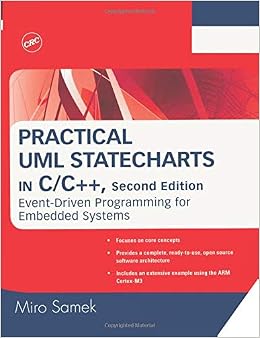
Free Download Practical UML Statecharts in C/C++

Free Download Practical UML Statecharts in C/C++

When getting Practical UML Statecharts In C/C++ as your analysis resource, you could get the straightforward method to evoke or get it. It requires for you to select and download and install the soft file of this referred book from the link that we have provided right here. When everyone has truly that great feeling to read this book, she or the will always assume that reading publication will certainly always direct them to obtain much better location. Wherever the location is for life much better, this is just what possibly you will certainly obtain when choosing this publication as one of your reading resources in spending spare times.

Practical UML Statecharts in C/C++

Practical UML Statecharts in C/C++


Practical UML Statecharts in C/C++


Free Download Practical UML Statecharts in C/C++

Practical UML Statecharts In C/C++. In what instance do you like checking out a lot? Just what regarding the kind of guide Practical UML Statecharts In C/C++ The needs to review? Well, everybody has their own factor why must check out some e-books Practical UML Statecharts In C/C++ Primarily, it will certainly connect to their need to obtain expertise from the e-book Practical UML Statecharts In C/C++ and desire to review simply to obtain amusement. Novels, tale book, and other entertaining publications come to be so popular this day. Besides, the clinical e-books will certainly also be the best factor to select, specifically for the pupils, educators, medical professionals, business person, and also other occupations who love reading.

This letter could not influence you to be smarter, however the book Practical UML Statecharts In C/C++ that we provide will certainly evoke you to be smarter. Yeah, a minimum of you'll understand greater than others that don't. This is what called as the high quality life improvisation. Why should this Practical UML Statecharts In C/C++ It's due to the fact that this is your favourite theme to review. If you such as this Practical UML Statecharts In C/C++ motif around, why do not you read guide Practical UML Statecharts In C/C++ to improve your discussion?

From the title, we will likewise show you the subject related to explain. When you actually need this type of resource, why don't you take it now? This publication will certainly not just give you the knowledge and also lesson regarding the subject, from words that are made use of, it specify new fun thing. This Practical UML Statecharts In C/C++ will make you feel no worry to invest more time in analysis.

Nevertheless, even this publication is produced based on the fact, one that is extremely interesting is that the author is really smart to make this publication very easy to check out and recognize. Appreciating the fantastic viewers to constantly have checking out behavior, every writer offers their best in using their thoughts as well as jobs. Who you are and also what you are does not come to be any type of large issue to obtain this book. After visiting this site, you can check even more about this publication and afterwards find it to recognize reading.

Practical UML Statecharts in C/C++

Review

"This book and the free QP download are your entry into the 21st century of embedded systems programming." — Rob Wehrli (Knoxville, TN), Amazon.com review"It is rare to find an author who is so strong theoretically, while paying such close attention to implementation details like microcontroller resource conservation."-- Robert Jones (MI USA), Amazon.com review"This book took me from being a C programming novice, to writing 1000s of lines of embedded control systems code, that has been running reliably for several years, with just one bug - my own!"— Haitham Hindi "H.H." (Palo Alto, CA), Amazon.com review

Read more

From the Author

The embedded software industry is in the midst of a major revolution. Tremendous amount of new development lays ahead. This new software needs an actual architecture that is inherently safer, more extensible, and easier to understand than the usual shared-state concurrency and blocking based on a traditional Real-Time Operating System (RTOS).This book provides and explains such a modern, event-driven architecture based on active objects (actors), hierarchical state machines, software tracing, graphical modeling and automatic code generation. While others only talk about these modern techniques, this book actually comes with practical, efficient, working software that has been battle-tested and proven in real-life systems.Welcome to the 21st century!

Read more

See all Editorial Reviews

Product details

Paperback: 750 pages

Publisher: Routledge; 2 edition (October 1, 2008)

Language: English

ISBN-10: 0750687061

ISBN-13: 978-0750687065

Product Dimensions:

7.4 x 1.7 x 9.7 inches

Shipping Weight: 2.8 pounds (View shipping rates and policies)

Average Customer Review:

3.8 out of 5 stars

29 customer reviews

Amazon Best Sellers Rank:

#1,016,659 in Books (See Top 100 in Books)

If you are an accomplished or aspiring embedded systems programmer and resort to the "superloop" as your foremost implementation method, you absolutely MUST read this book.While not new concepts to the industry, the concepts presented in Miro's book are certainly not commonplace in many of the embedded systems code I've seen over many years in the industry.While UML makes for a clean, now defacto standard for presenting concepts, the real beauty in Miro's book is the use of a readily-available frameworks for immediately adopting the many lessons-learned and provided in the book. These complete, well written and excellently coded frameworks are available under the GPL and an alternate, low-cost license for those who wish to keep their code private.For strong C programmers, the implementation of the frameworks is a delight as one reads through the code and is treated to an incredibly simple, lightweight and extremely powerful system that will forever put an end to your future plans to "superloop" again--albeit for any system where C (or C++) is adequately supported by the hardware. For anyone admitting that "we've always done superloop and it has always worked in the past," get ready for a real-time, highly responsive system that actually IS event driven and thrives in as little as a few bytes of RAM and perhaps a K of ROM.For those who must hold on to the "superloop is king" mindset, consider the consequences of adding to your superloop an entirely new set of features and how that may affect the timing through your loop. I started with the "dining philosophers" example code discussed in the book and ported it to my own board (using a Renesas H8S-2166 microcontroller) and augmented the code to be responsive to external events (mechanical switches). This required software debouncing. While my "example" was somewhat "trivial" in terms of what the functionality actually did, it is, in my opinion, extremely typical of changing requirements of both new and legacy code in the day-to-day evolution of embedded systems programming.My changes to the example code were to implement a "bike light" feature set. That is, whenever a switched was pressed, the bike light--if off--would illuminate. An LED on the board was used for this purpose. Pressed again, the light would blink. Pressed and held for 1 second while on or blinking, the light would turn off.The typical implementation in superloop would often require a considerate approach to ensure that the new functionality was "injected" into the "right" part of the loop, so as to be of minimal impact to other areas of critical timing code. If any kind of action within the new code delayed the loop processing, then the whole of the superloop could come under further scrutiny and therefore cause more pain as one trials and tests system responsiveness on a number of potential new fronts.Atop of this new functionality, the frameworks-provided QSpy code instrumentation system, which allows one to have a stream of information about the system states and transitions, was ported to use a UART on the H8S. Imagine adding all of this new functionality in a traditional superloop body of code. Now, imagine adding it in a matter of perhaps two hours using the frameworks AND not adversely impacting the "legacy" application code at all!One of the most beautiful aspects of these frameworks is the ability to focus strictly on the code necessary for the task at hand instead of the entire system as a whole. The frameworks substantially frees the programmer from having to manually manage system responsiveness typical of the superloop.Using UML to design and document an embedded system is relatively new to many embedded systems programmers. Miro also provides a free download stencil set for MS Visio for easily implementing statecharts, which should help those interested in pursuing the many benefits of the technology included in this book.I first met Miro at a developer's conference in San Diego, CA. One thing that comes out in his book and his discussions of this exciting technology is his passion for it. I was very interested in it, as he was displaying his software running on a very resource constrained microcontroller--all in about 40 bytes of RAM or a bit less.Drawn to his topic by his enthusiasm, I admired the frameworks even more as I began looking at the implementation and design of the code. The entire C bundle, with royalty-free 'private commerical use' license, one of either cooperative or preemptive schedulers (both are provided), event processor, code instrumentation support and more is all for under $2K. Of course, one may explore the entire frameworks for the cost of only a free download before ever making a licensing decision for a given product.Combined with the low-cost solution of using such powerful frameworks in conjunction with learning the valuable content of this book, teams everywhere can exploit the years of experience and very robust, capable code in a matter of hours instead of weeks, months and even years of doing things the "old school" way using superloops and other facilities instead of truly event-driven designs.This book and the free QF download are your entry into the 21st century of embedded systems programming. Because the code is provided in C, porting is rather easy and running on embedded systems and desktop systems is practical and easy. I was able to build and run the code as provided without modifications on my Linux, Mac and Windows systems and on the H8S and a Microchip PIC 24 with only a minimalist porting effort of about a half a day in each case. Imagine being able to run an entire real-time system that features excellent extensibility while freeing you from the rigors of managing superloop timing on your own hardware all within a few hours. Then, spend a couple of hours extending the system without impacting the rest of it? Lather, rinse, repeat...it is truly that simple and robust.Best of all, this book will open your eyes to modern methods and concepts for programming event-driven embedded systems. That is, systems that respond to internal and external events that naturally occur in all embedded systems designs. It is my firm belief that after reading this book and exploring the code on your own, you'll discover why I so heartily endorse it and now share the passion Miro has for this wonderful, very lightweight but robust, complete solution for modern embedded systems programming.

It is rare to find an author who is so strong theoretically, while paying such close attention to implementation details like microcontroller resource conservation. The Nano product, for example, shows he has his eye on the low end 8 bit embedded world, not just the Gigahertz microcontrollers used in smart phones and the like.I've tried all the ways to make state machines in C and assembler, and I have to say the function pointer method is by far the best. He spent lots of time on the underpinnings of both flat and hierarchical state machines, and went through the process of implementing simple state machines using the various methods that have been tried before. At the end, not only do you feel comfortable with complex state machines, but you can really understand WHY the way taught in the book is the best way. One it "clicks", you will never go back again. I'm completely sold.If that weren't enough, he adds a real-time framework to the state machine skeleton which includes a task scheduler, an event queue, and a built-in method to encapsulate the various state machines into active objects. This way, you can run concurrent orthogonal and nested state machines without getting lost in the details. It's all so well organized, I feel like I've been a hack programmer up until now.I do have a quibble though. It's not the product - it's the book. It's already getting a bit out of date. The book doesn't cover QM - the modeling tool - at all. It also doesn't cover QT integration, which is a great method of building your virtual prototype on your desktop before committing it to your target. If you want an end-to-end development environment, QM and QT are golden. QT is an outstanding C/C++ development environment in its own right, and the GUI features seal the deal.Finally, I hope the next version (which I will almost certainly buy) comes out on Kindle - to save some trees.

I am impressed, the book handles a difficult topic very well. BTW, this is my first 5-star rating, ever. One gets both a high-level picture, as well as detailed examples. What I especially appreciate is that the author anticipates my questions and covers them well. I am actually an application (.NET/GUI), not embedded, developer; yet this is by far the best source on state-machines and event-driven programming I have found. I did notice few typos, but they did not cause much confusion.

This is an excellent book describing the statecharts approach to state machine programming. My only complaint is that I wish more practical examples were discussed, top-to-bottom including their implementation on a number of target platforms, and slightly less attention paid to the theory. Other than that wish, this is still an excellent way to start coding state machines using UML statecharts.

Practical UML Statecharts in C/C++ PDF
Practical UML Statecharts in C/C++ EPub
Practical UML Statecharts in C/C++ Doc
Practical UML Statecharts in C/C++ iBooks
Practical UML Statecharts in C/C++ rtf
Practical UML Statecharts in C/C++ Mobipocket
Practical UML Statecharts in C/C++ Kindle

Practical UML Statecharts in C/C++ PDF

Practical UML Statecharts in C/C++ PDF

Practical UML Statecharts in C/C++ PDF